Klaviyo vs Mailchimp: Which Email Automation Service is Better?
By Marcus Hale · Updated Oct 2026
Klaviyo vs Mailchimp priced at 5,000 and 10,000 contacts, with free-plan caps, the first-year promo, and who should skip both: coaches and course sellers.
Short answer
This is a store question. Klaviyo wins for a shop whose emails should react to what people browse, cart and buy; Mailchimp wins for a shop that mostly sends newsletters, a welcome email and one cart reminder, and for anyone who wants five logins and a first-year discount. At list price they are almost level: $100 a month at 5,000 contacts on both, and $135 (Mailchimp Standard) against $150 (Klaviyo Email) at 10,000. If you are a coach or course seller with no online store, skip both and read the Kit and ActiveCampaign comparisons linked below.
Who should read this comparison
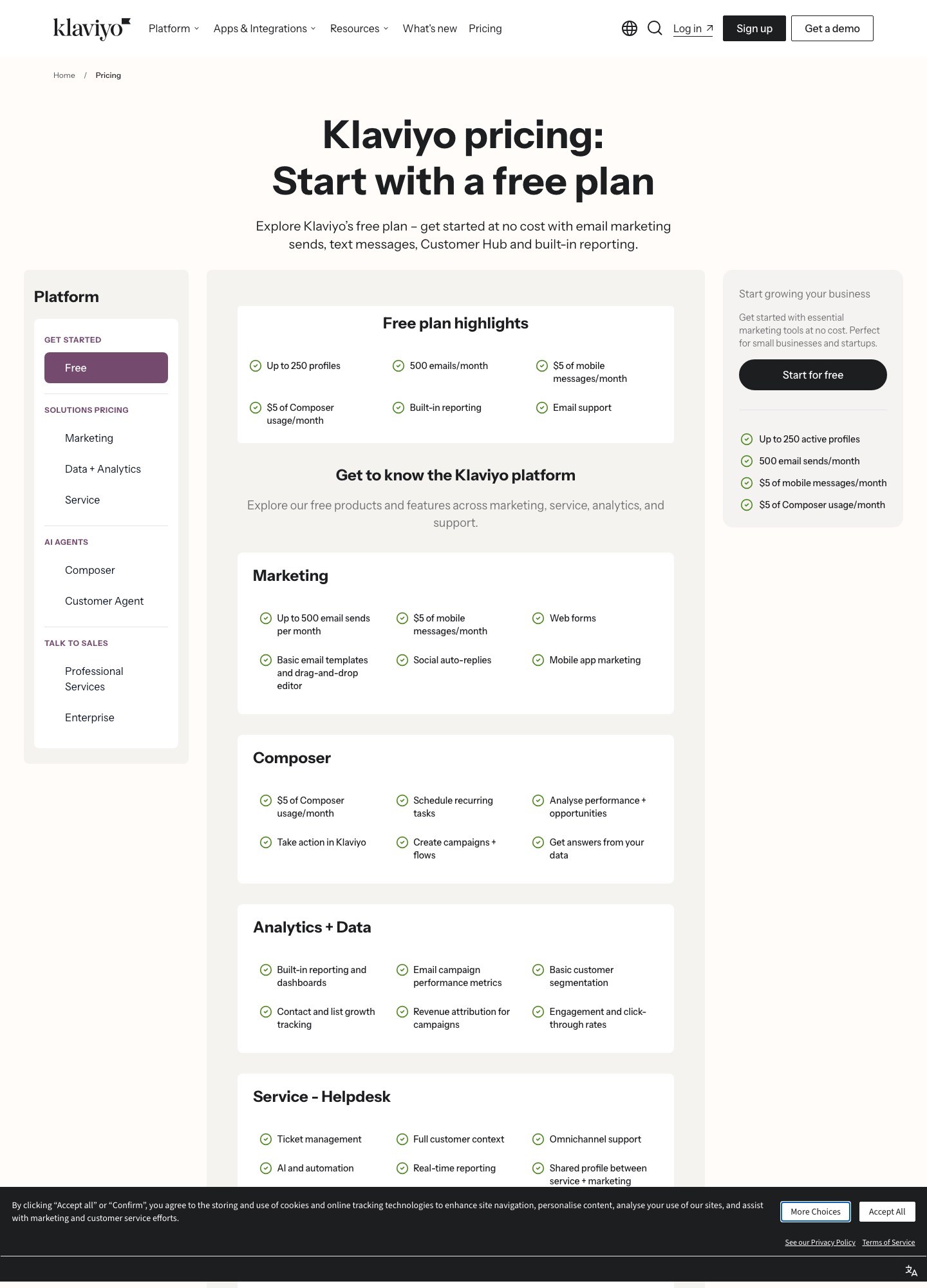
Read it if you sell products through a store platform and you are choosing where the abandoned-cart, post-purchase and win-back emails will live. Klaviyo's pricing page sorts its capabilities under marketing, analytics and data, and service, and puts revenue attribution for campaigns and basic customer segmentation on the free plan. That emphasis is why stores treat it as the benchmark. Mailchimp's pricing page sorts its plans by automation flows, seats, audiences and templates, which describes a general-purpose sender that happens to connect to stores.
Skip it if you are a coach, course creator or consultant. Your purchases come through a checkout, a booking tool or a course platform, not through a store feed, so the thing Klaviyo is built around is mostly absent. The honest answer for you is on a different pair of pages: Kit for a course seller, ActiveCampaign for a consultant who books calls. Both are linked in the sections below and priced against the same Mailchimp tiers used here.
Price at 5,000 and 10,000 contacts
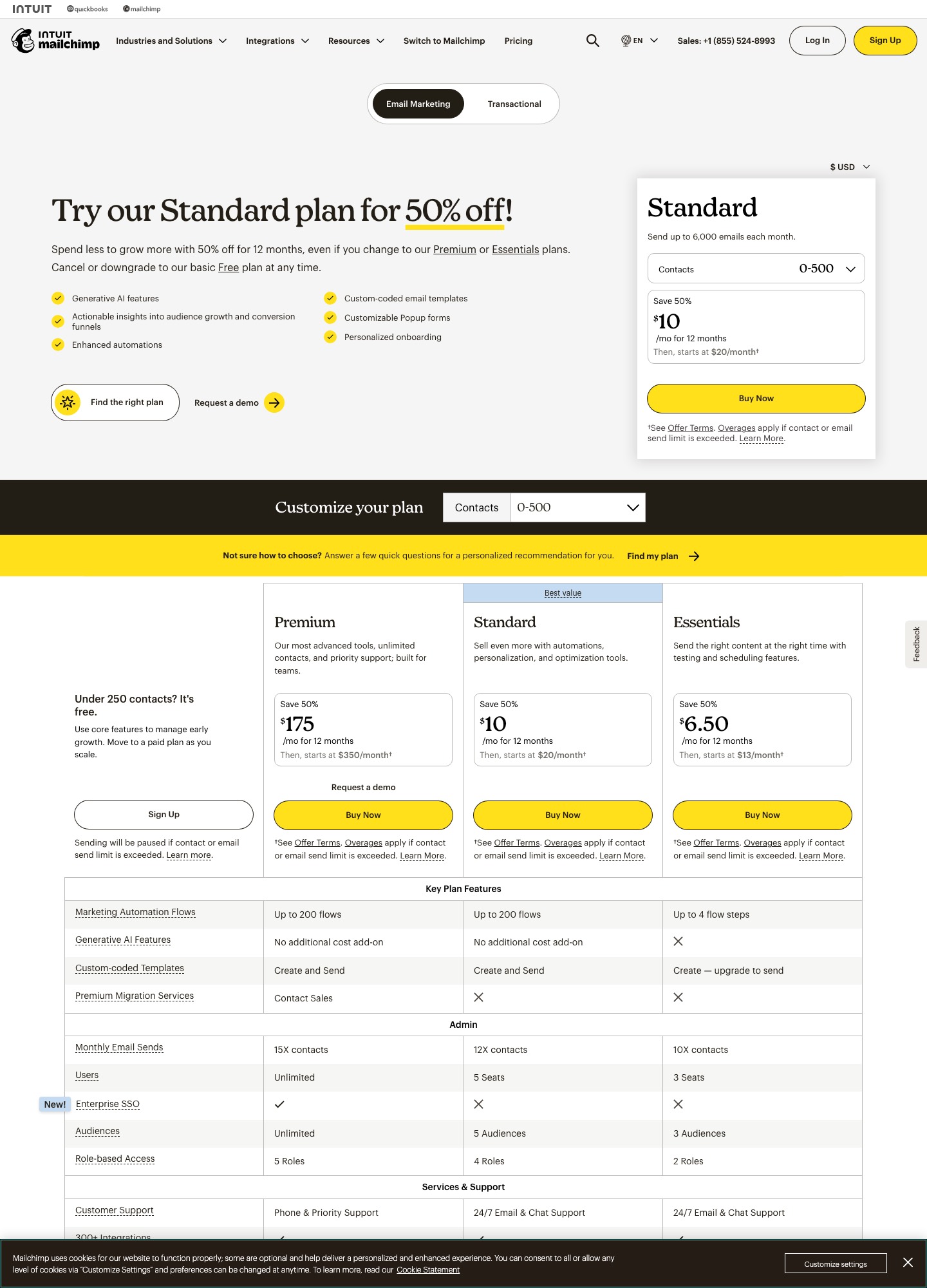
The two tools count different things. Klaviyo's Email plan is priced by profiles, and its free plan is described as up to 250 active profiles. Mailchimp's Standard plan is priced by contact band, and each band shows a 50% discount for the first 12 months. Figures below come from Klaviyo's pricing page and Mailchimp's pricing page, read on 2026-10-07.
| List size | Klaviyo Email | Mailchimp Standard | Mailchimp first-year rate |
|---|---|---|---|
| Free plan | Up to 250 active profiles, 500 emails a month | 1 audience, 250 contacts, 500 sends a month | Not applicable |
| Entry | $20 at 500 profiles, $30 at 1,000 | $20 at 500 contacts (Essentials from $13) | Not shown for this band |
| 5,000 | $100 a month | $100 a month (band 2,501-5,000) | $50 a month |
| 10,000 | $150 a month | $135 a month (band 5,001-10,000) | $67.50 a month |
| 15,000 | Read the figure from Klaviyo's calculator | $230 a month (band 10,001-15,000) | $115 a month |
Turn that into a year and the pattern is plain. At 5,000 contacts Klaviyo is $100 x 12 = $1,200 a year. Mailchimp Standard is $50 x 12 = $600 in year one and $100 x 12 = $1,200 from year two, so from month 13 the two tools cost the same. At 10,000 contacts Klaviyo is $150 x 12 = $1,800, and Mailchimp is $67.50 x 12 = $810 in year one and $135 x 12 = $1,620 afterwards. Klaviyo costs $990 more than Mailchimp in the first year and $180 more in every year after that.
Two things the price rows leave out. The Klaviyo pricing text read for this comparison gives no send allowance for its paid Email plan, while Mailchimp's page lists monthly sends as 10x contacts on Essentials, 12x on Standard and 15x on Premium, which is 60,000 sends at 5,000 contacts on Standard. And above 10,000 profiles the Klaviyo number has to be read from its own calculator, so a store growing past that size should price Klaviyo on the day it signs, not from this page. Cleaning the list is worth doing before either. Moving from 10,000 to 5,000 people takes Klaviyo from $150 to $100, $600 a year, and Mailchimp Standard from $135 to $100, $420 a year.
A store's first year, flow by flow
Take a shop with 5,000 contacts that wants five automated journeys: a welcome email, an abandoned cart, a browse follow-up, a post-purchase thank-you and a win-back for people who have not ordered in a while. The tools differ less in whether they can send those emails than in what each is allowed to react to and how many flows the plan lets you build.
On Mailchimp's page, Essentials is limited to up to 4 flow steps, while Standard and Premium allow up to 200 flows. A five-journey store therefore starts on Standard, which is $100 a month at 5,000 contacts ($50 for the first 12 months), with 5 seats and custom-coded templates that can be built and sent. On Klaviyo the same journeys sit on the Email plan at $100 a month at 5,000 profiles, and the revenue each one earns is reported on the page's own analytics list under revenue attribution for campaigns.
The practical test before you pay either is a segment built from the order record: customers who bought once in the last 60 days, have not bought a second time and opened one email in the last 30. Build it in each trial. The tool where that segment takes one screen, with no spreadsheet and no tag you maintain by hand, is the one that matches how your store sells. For a store that never segments past "customers" and "subscribers", the extra depth is something you pay for and do not use.
Where Klaviyo is the better choice
Klaviyo wins when store data is the reason to buy email software. A shop with a few hundred products, repeat customers and a real catalog has more to segment on than a newsletter list does, and revenue attribution on the free plan lets you see what each campaign earns before you commit to a paid tier. The cost of that is a steeper profile bill at the top end: $150 a month at 10,000 profiles against $135 on Mailchimp Standard, $180 a year more once the Mailchimp promotion ends.
It also wins if you expect the list to grow quickly and want one place to see revenue by campaign. Mailchimp's first-year rate is a real saving, $990 at 10,000 contacts, but it ends after 12 months and the list you built on it is the one you pay full price for later.
Where Mailchimp is the better choice
Mailchimp wins for a store that is mostly a newsletter. A shop that sends one weekly email, a welcome series and a cart reminder does not need to segment on order history, and the 50% first-year rate ($50 at 2,501-5,000 contacts, $67.50 at 5,001-10,000) makes it the cheaper tool for twelve months. Its Standard plan gives 5 seats and sends at 12x your contact count, so a founder, a designer and a part-time marketer can all work in the account, and its Free plan covers a launch list under 250 people.
It is also the safer first choice when the store is new and you do not yet know what you will segment on. Starting on Mailchimp and moving to Klaviyo once order data justifies it costs one rebuild of the flows, and the list moves as a CSV.
If you are a coach or course seller, neither
Klaviyo's edge is the feed from an online store. A coach selling a program through a checkout page, a booking calendar or a course platform has no store to feed it, so the price you pay for Klaviyo's depth buys little. Mailchimp is a reasonable newsletter tool for you, but two cheaper tools are built for what you actually sell.
For a course creator with a list of subscribers and a few products, Kit (formerly ConvertKit) is the better pick. Its pricing page lists Creator at $75 a month for 5,000 subscribers and $116 for 10,000, billed yearly, and a Free plan up to 10,000 subscribers without Visual Automations (kit.com/pricing). At 5,000 that is $25 a month below both Klaviyo and Mailchimp at list price, $300 a year, and at 10,000 it is $19 below Mailchimp Standard and $34 below Klaviyo. The Kit vs Mailchimp comparison sets it against Mailchimp in full.
For a consultant who books discovery calls, ActiveCampaign is the stronger pick: its Starter plan reads $79 at 5,000 contacts and $149 at 10,000, billed annually, and its Plus plan $145 and $189 (activecampaign.com/pricing). Starter allows 1 user and 5 actions per automation, so serious follow-up starts on Plus. Mailchimp vs ActiveCampaign works through the plan limits and the deal-stage logic.
Switching a store between Mailchimp and Klaviyo
| Piece | Mailchimp to Klaviyo | Klaviyo to Mailchimp |
|---|---|---|
| People | Export the audience as a CSV; map each merge field to a profile property before the import | Export profiles with their properties; each property needs a matching merge field in Mailchimp |
| Order history | Reconnect the store and check how far back order data arrives, because segments built on past purchases are only as good as that history | Mailchimp's store connection has to be set up again, and anything beyond what it syncs will not exist as a segment |
| Flows | Each journey is rebuilt as a flow; a cart trigger needs the store connection live first | Each flow is rebuilt as a journey; count steps, because Essentials allows up to 4 |
| Unsubscribed people | Carry opt-outs and cleaned addresses across as their own file and load them first. A store that mails a shopper who unsubscribed has a consent problem as well as a deliverability one. | |
| Profile count | Drop people who have not engaged in a long time before importing. Every 5,000 you remove at the 10,000 level saves $50 a month on Klaviyo and $35 a month on Mailchimp Standard. | |
Where this store decision goes wrong
- Budgeting a three-year plan on Mailchimp's first-year rate. At 5,000 contacts $50 becomes $100 in month 13, so the second year is $1,200, level with Klaviyo.
- Reading Klaviyo's free plan as a store plan. It stops at 250 active profiles and 500 emails a month, the same ceiling as Mailchimp's 250 contacts and 500 sends.
- Pricing Klaviyo past 10,000 profiles from this page. The figures here stop at $150 for 10,000; read the next band from Klaviyo's calculator.
- Choosing Mailchimp Essentials for a five-flow store. Up to 4 flow steps does not fit a welcome, cart, browse, post-purchase and win-back set.
- Buying Klaviyo because it is the store tool when you are not a store. A coach on Klaviyo pays for a connection to a platform they do not use.
Verdict
For a store: Klaviyo if you will segment on orders and browsing, Mailchimp if you mostly send newsletters. At 5,000 contacts they cost the same at list price, $100 a month, and at 10,000 Klaviyo is $15 a month higher. Mailchimp's 50% first-year rate undercuts Klaviyo by $600 at 5,000 contacts and $990 at 10,000 for twelve months, and that is the strongest reason to start there if segmentation depth is not yet your bottleneck.
For a coach or course seller: neither. Kit is the better pick for a course creator, ActiveCampaign for a consultant who books calls, and the two comparison pages linked above price each against Mailchimp. Prices are from klaviyo.com/pricing and mailchimp.com/pricing, read on 2026-10-07.
Related comparisons
- Kit (formerly ConvertKit) vs Mailchimp: The first stop for a coach or course seller with no store: Kit lists Creator at $75 for 5,000 subscribers and a Free plan up to 10,000.
- Mailchimp vs ActiveCampaign: The pick for a consultant who books calls and needs follow-up by tag and deal stage.
- Omnisend vs Klaviyo: If Klaviyo is your store benchmark, this prices its closest ecommerce rival against it.
- HubSpot vs Mailchimp: For a business that tracks deals and wants email on the same record.
Frequently asked questions
Is Klaviyo better than Mailchimp for an online store?
For a store whose emails should react to what people viewed, carted and bought, Klaviyo is the better specialist: its pricing page lists revenue attribution for campaigns and basic customer segmentation inside the free plan, so you can see revenue against a campaign before paying. For a store that sends a weekly newsletter, a welcome email and one cart reminder, Mailchimp does that job at the same list price, and with a 50% first-year discount it is the cheaper of the two for twelve months.
Is Klaviyo more expensive than Mailchimp?
At list price they are close. Klaviyo's Email plan reads $100 at 5,000 profiles and $150 at 10,000; Mailchimp Standard reads $100 at 2,501-5,000 contacts and $135 at 5,001-10,000. The gap is $0 at 5,000 and $15 a month at 10,000, which is $180 a year. In year one Mailchimp shows $50 and $67.50 for those bands, so Klaviyo costs $600 and $990 a year more for twelve months, and then the gap closes.
Do both have a free plan?
Yes, with almost the same caps. Klaviyo's page lists up to 250 active profiles and 500 emails a month. Mailchimp's lists 1 audience, up to 250 contacts and 500 sends a month, with 250 as the most in a day. Both stop you at 250 people, so neither is a home for a store with a list of a few thousand.
Which should a coach or course creator pick?
Neither as a first choice. Klaviyo's advantage is the connection to a store, and a coach selling a program usually has no store platform to feed it. Kit (formerly ConvertKit) is built for creators and lists a Free plan to 10,000 subscribers; ActiveCampaign suits a consultant who books calls. Both are priced against Mailchimp on their own pages, linked below.
What happens to my Mailchimp price in month 13?
The 50% promotion shown on Mailchimp's pricing page lasts 12 months. At 2,501-5,000 contacts the $50 becomes $100, and at 5,001-10,000 contacts the $67.50 becomes $135. Budget the second year on the full rate, which makes Mailchimp $1,200 and $1,620 a year at those two sizes.
Will cleaning my list lower the bill?
On both tools, yes. Moving from 10,000 to 5,000 people takes Klaviyo's Email plan from $150 to $100, a $50 saving a month or $600 a year, and Mailchimp Standard from $135 to $100, a $35 saving a month or $420 a year. Remove people who have not opened in a long time before you import them into either tool.