Sequenzy vs Kit (ConvertKit): Which Fits Course Sellers?
By Marcus Hale · Updated Oct 2026
TL;DR
Course creators, coaches and newsletter writers should choose Kit (formerly ConvertKit). Choose Sequenzy if you sell software on a subscription and want emails triggered by Stripe, Paddle or Lemon Squeezy billing events, trials and cancellations. Kit is free up to 10,000 subscribers (without automations) and Creator costs $33 a month at 1,000 subscribers. Sequenzy is free for 2,500 emails a month, then $19 for 15,000.
One tool organizes around an audience, the other around accounts
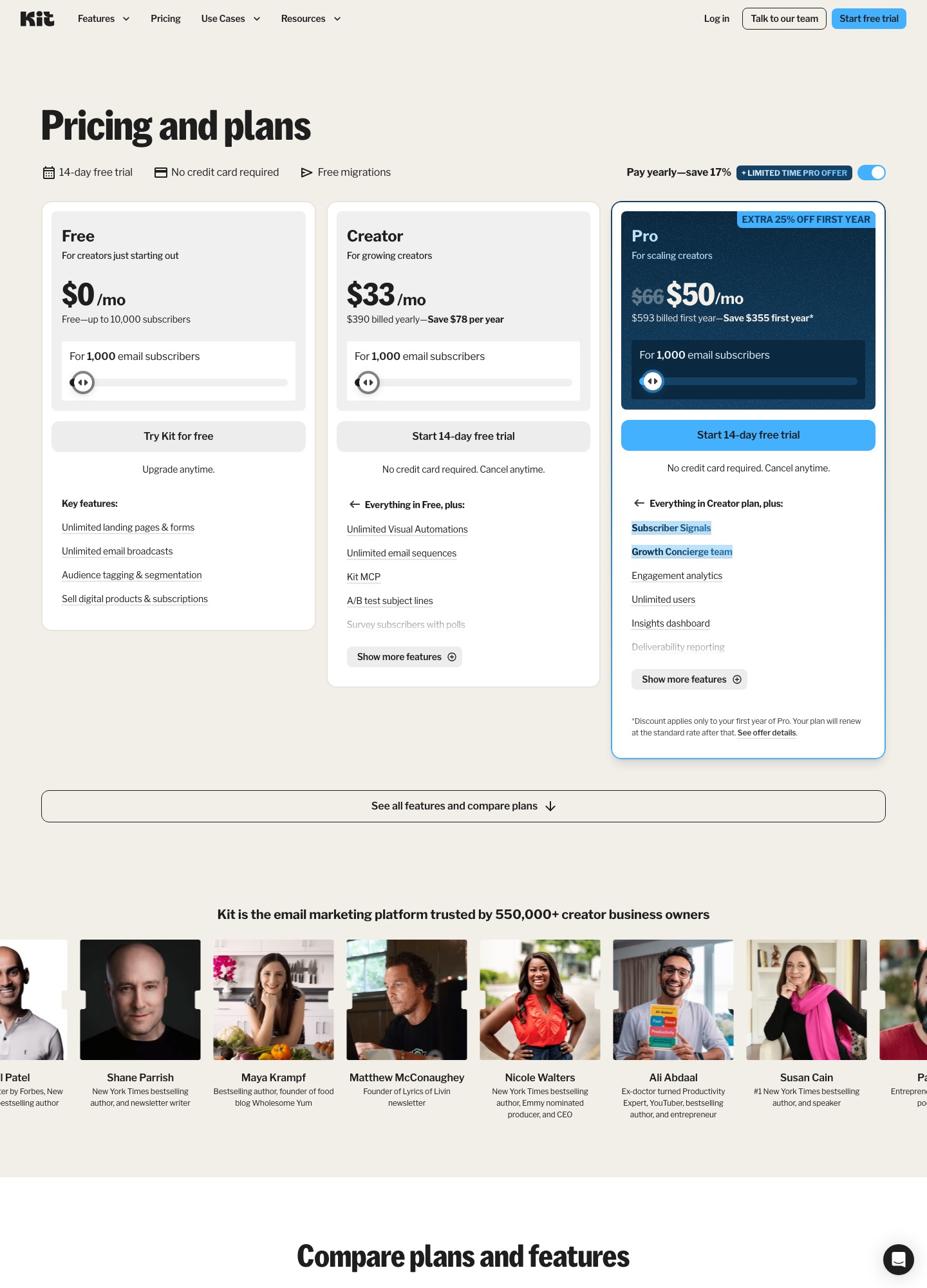
Kit (formerly ConvertKit) treats your list as an audience you grow and sell to. Its free plan already includes unlimited landing pages and forms, unlimited email broadcasts, tagging and segmentation, and a way to sell digital products and subscriptions. Visual Automations and email sequences start on the Creator plan. Everything is arranged so a person can join through a lead-magnet page, get tagged by what they asked for and later buy a course or a paid newsletter.
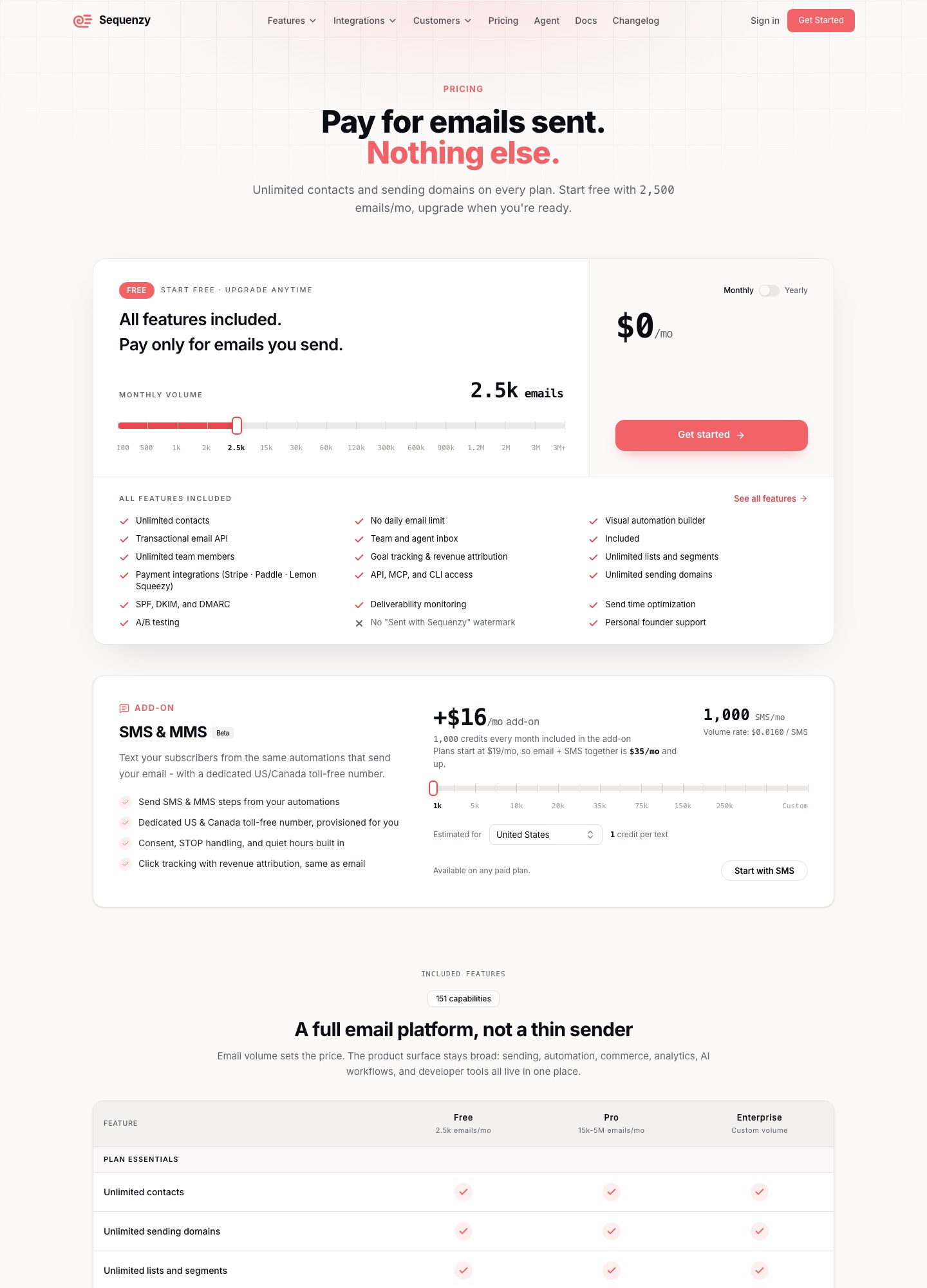
Sequenzy treats your list as customers of a software product. Its pricing page presents one platform for transactional and marketing email, billing-event and product-event automations, and revenue attribution, with every feature included from the free tier up. It also takes a different position on pricing: you pay for the emails you send, while contacts and sending domains are unlimited. That makes the two tools hard to compare on list size alone, which is why the cost section further down fixes a mailing schedule.
| Side by side | Kit (formerly ConvertKit) | Sequenzy |
|---|---|---|
| Aimed at | Creators: course sellers, newsletter writers, coaches | SaaS and subscription products |
| Free plan | Up to 10,000 subscribers; landing pages, forms, broadcasts and tagging; no Visual Automations or sequences | 2,500 emails a month with all features, no card needed |
| Paid price | Creator $33 at 1,000 subscribers, $75 at 5,000, $116 at 10,000, $166 at 25,000, billed yearly | $19 for 15,000 emails, $29 for 30,000, $49 for 60,000, $99 for 120,000 |
| Upper plan | Pro: $66 at 1,000 subscribers (a first-year offer shows $50), $158 at 10,000, $233 at 25,000 | No second plan family; the volume tier is the only step |
| Automation | Unlimited Visual Automations and sequences from Creator | Visual builder and AI-drafted sequences on every plan |
| Pages and selling | Unlimited landing pages and forms; sells digital products and subscriptions | No landing-page builder or product checkout listed |
| Billing events | No billing triggers listed | Stripe, Paddle, Lemon Squeezy and others; dunning emails on invoice.payment_failed |
| Trying and moving | 14-day trial without a card; free migrations | Free tier in place of a trial |
| People and support | Creator adds 24/7 email and chat support; Pro adds unlimited users | Unlimited team members and a shared team and agent inbox |
Costs at 1,000, 5,000 and 10,000 subscribers
The assumption here is a twice-weekly newsletter, which is eight emails a month to everyone. A launch month adds a three-email cart-close sequence to the whole list, so eleven emails per contact. Kit's figures are the monthly rate of the Creator plan billed yearly; Sequenzy's come from the volume tiers on its pricing page.
| Subscribers | Emails sent: normal / launch month | Sequenzy: normal / launch | Kit Free | Kit Creator |
|---|---|---|---|---|
| 1,000 | 8,000 / 11,000 | $19 / $19 | $0 | $33 |
| 5,000 | 40,000 / 55,000 | $49 / $49 | $0 | $75 |
| 10,000 | 80,000 / 110,000 | $99 / $99 | $0 | $116 |
How the Sequenzy column is built: 1,000 subscribers times 8 is 8,000 emails, over the 2,500 free allowance and inside the 15,000-email tier, and 11,000 in a launch month is still inside it. At 5,000 subscribers, 5,000 times 8 is 40,000 emails and 5,000 times 11 is 55,000, and both fit the 60,000-email tier. At 10,000 subscribers, 80,000 and 110,000 emails both fit the 120,000-email tier. Set against Kit Creator, that leaves Sequenzy cheaper in every row: Kit asks 14 dollars more a month at 1,000 subscribers, 26 dollars more at 5,000 and 17 dollars more at 10,000.
Two points keep that table honest. First, Kit's Free column is only a fair comparison if you broadcast without sequences, since Visual Automations and sequences are listed from Creator. Second, Sequenzy's lead shrinks as you mail more often: at four emails a month the 10,000-subscriber list needs only the 60,000-email tier at $49, but at eight it needs the $99 tier, close to Kit's $116. Kit also publishes $166 at 25,000 subscribers for Creator, and its Pro plan is $158 at 10,000 subscribers and $233 at 25,000.
A course seller's funnel on each tool
Take a course creator with 5,000 subscribers and a $297 course. The funnel has four moving parts: a landing page offering a free checklist, a form that tags the person by the checklist they chose, a five-email welcome sequence that ends with the course pitch, and a product page where the course is bought. On Kit the page, form, tag, sequence and sale all sit in one account. The free plan covers the first two and the sale, and the sequence is the reason to move to Creator at $75 a month for 5,000 subscribers, billed yearly (about $900 over the year).
On Sequenzy the sequence is easy to build, and the visual builder and AI-drafted sequences cost nothing extra. The pieces around it are missing from its pricing page: a landing page for the checklist, a product checkout and the tag-by-interest habit that Kit's whole interface is arranged around. You would add a page tool and a payment tool, wire them through Zapier or a webhook, and recreate the "tagged as interested in X" state yourself. For one course, the $26 monthly saving at this size can be eaten by those extra subscriptions alone.
There is also a quieter reason to pick Kit here: the free plan. A creator whose emails are weekly broadcasts to 8,000 people pays nothing on Kit, while the same list mailed four times a month is 32,000 emails and costs $49 on Sequenzy. Free ends the moment you want a welcome sequence, since sequences start on Creator, but many writers never need one.
A SaaS founder's funnel on each tool
Now take a software founder with 5,000 trial and paying users who sends about 18,000 emails a month: signup welcome, a trial-ending reminder, failed-payment notices, cancellation win-backs and one monthly product update. That volume sits in Sequenzy's 30,000-email tier at $29 a month, against $75 for Kit Creator at the same count.
Price is the smaller part. Each of those emails starts from a billing or product event, and Sequenzy's pricing page lists Stripe, Paddle, Lemon Squeezy, Polar, Creem and Dodo among the integrations on every plan. Its homepage says a Stripe invoice.payment_failed event starts dunning with a card-update page, and it describes win-back on cancellations and upsells triggered by usage limits. That is email dunning only: the charge retry stays in the billing system. In Kit, the same flows would depend on something outside it applying a tag when the payment fails, and Kit's pricing page names no billing triggers. For this founder, Sequenzy is the better pick and the cheaper one.
Moving between Kit and Sequenzy
- Kit to Sequenzy: subscribers and their tags export as a file. Rebuild each sequence in Sequenzy's builder, but rethink the triggers: a Kit sequence that starts when a "bought-course" tag is applied becomes a flow that starts on a payment event. Forms and landing pages stop working once you remove Kit's embeds, so replace them before the cutover. Anything you sold through Kit's product pages needs a new checkout.
- Sequenzy to Kit: Kit's pricing page lists free migrations and a 14-day trial with no credit card, which makes trying it cheap. Plan, MRR and engagement segments do not exist as such, so keep them as tags or fields you update from your billing tool. Remember that sequences need Creator, not Free.
- Both directions: carry unsubscribes and complaints across as suppressed contacts before the first send, authenticate the sending domain in the new account, and send the most recently engaged people first. Run both for one full pass of your longest sequence so nobody who already bought gets the pitch again.
Where this pair trips people up
- Budgeting from Kit's Pro promotion. The $50 shown on the pricing page is a first-year offer on a plan quoted at $66 for 1,000 subscribers; the plan then renews at the standard rate.
- Counting Kit's $33 as a monthly price. It is the monthly rate for yearly billing, shown beside $390 a year at 1,000 subscribers, so you commit to the full year up front.
- Forecasting Sequenzy from the list size. A twice-weekly newsletter to 10,000 people is 80,000 emails and the $99 tier; a monthly digest to the same list is 10,000 emails and the $19 tier.
- Assuming Kit's free plan includes automations. It does not, so a "free" welcome sequence turns into a $33 plan the day you build one.
- Choosing Sequenzy for a course business to save money and then discovering you need a page builder and checkout it does not list.
The verdict, for both readers
For course creators, coaches and newsletter writers: Kit. The audience tools you need, such as landing pages, forms, tags, sequences and a way to sell, are in one product, and the free plan stays free to 10,000 subscribers if you only broadcast. Budget $33 a month at 1,000 subscribers, $75 at 5,000 and $116 at 10,000 for Creator. If you already have a page builder and checkout and only need a sender, Sequenzy's lower bill is a fair reason to choose it.
For SaaS and subscription founders: Sequenzy. Billing-triggered emails, trial flows and cancel flows are what it is built for, and it charges on sends rather than list size. See current prices on sequenzy.com/pricing and kit.com/pricing.
Related comparisons
If you are still deciding on a creator tool, the comparison hub and the guide to email automation tools for creators cover more options.
- Kit (ConvertKit) vs Mailchimp: The creator-side comparison, priced at the same list sizes.
- Sequenzy vs ActiveCampaign: The pick for coaches who need a CRM and landing pages.
- Sequenzy vs Drip: The same SaaS question put against a store-first tool.
- Kit (ConvertKit) alternatives: Where creators go when the subscriber bill outgrows them.
Frequently asked questions
Is Kit the same product as ConvertKit?
Yes. ConvertKit is now called Kit, and its pricing lives at kit.com/pricing. This page keeps the convertkit address so older links still land here, and uses Kit (formerly ConvertKit) for the product.
Can I automate emails on Kit's free plan?
Not with Visual Automations or sequences, which Kit's pricing page lists from the Creator plan. Creator is $33 a month at 1,000 subscribers when billed yearly. The Free plan covers up to 10,000 subscribers with landing pages, forms, broadcasts and tagging. That is enough for a newsletter-only list but not for a welcome sequence.
Which is cheaper at 5,000 subscribers?
Sequenzy on the invoice, as long as you send under about 60,000 emails a month. At 5,000 subscribers mailed eight times a month (40,000 emails), Sequenzy's 60,000-email tier is $49. Kit's Creator plan at that size is $75 a month, billed yearly. Kit's free plan costs nothing there but has no automations, and the price gap does not cover landing pages or product sales, which Kit lists and Sequenzy's pricing page does not.
Can Kit run failed-payment or trial-ending flows for a SaaS?
Not out of the box. Kit's pricing page lists no Stripe, Paddle or Lemon Squeezy triggers, so those flows would rely on a connector that applies tags from your billing system. Sequenzy lists those integrations and says a Stripe invoice.payment_failed event starts a dunning email flow with a card-update page.
Does Sequenzy retry failed cards?
No. It sends the dunning emails and a card-update page, while retrying the charge is the job of Stripe, Paddle or whichever billing system you use. No recovery rate is claimed on this page.